


Introduction: The Promise and the Pitfalls of Online Jewelry Shopping
Buying fine jewelry online has never been more accessible — or more risky. With thousands of retailers competing for your attention, it can be hard to tell a trustworthy jeweler from a convincing scam. The good news? Once you know what to look for, shopping for diamonds, gold, and gemstones online can be just as safe — and far more convenient — than walking into a store.
This guide covers everything you need to know before you click "buy": certifications, hallmarks, return policies, red flags, and the questions every smart shopper should ask.
1. Understand What "Fine Jewelry" Actually Means
Not all jewelry is created equal. Before you shop, it helps to understand the terminology:
- Fine jewelry is made from precious metals (gold, platinum, sterling silver) and genuine gemstones (diamonds, sapphires, rubies, emeralds, etc.).
- Fashion or costume jewelry uses base metals and synthetic or simulated stones — it's not inherently bad, but it's not fine jewelry.
- Vermeil is sterling silver coated in gold — a legitimate category, but different from solid gold.
- Gold-filled vs. gold-plated: Gold-filled has a thicker layer of gold and lasts longer. Gold-plated is a thin coating that can wear off quickly.
Always confirm exactly what you're buying. A reputable retailer will be transparent about materials.
2. Look for Metal Hallmarks and Certifications
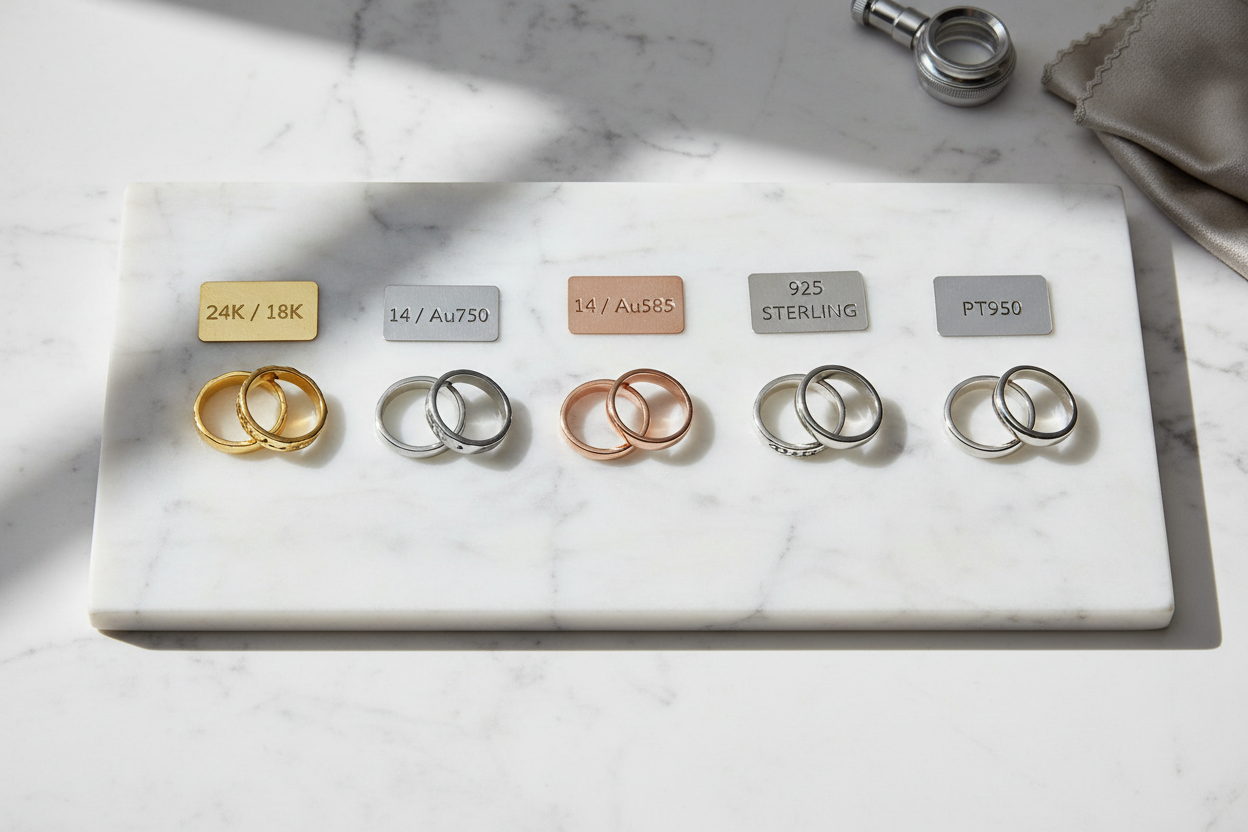
Hallmarks are small stamps on jewelry that indicate the metal's purity. They're one of the most reliable ways to verify what you're buying.
Gold Hallmarks to Know:
- 24K = 99.9% pure gold (very soft, rarely used in jewelry)
- 18K = 75% gold (premium, durable, common in fine jewelry)
- 14K = 58.3% gold (most popular in the US — great balance of quality and value)
- 10K = 41.7% gold (minimum legal standard for "gold" in the US)
Platinum:
- Look for stamps like 950 Pt, Plat, or PT950 — indicating 95% pure platinum.
Silver:
- 925 = Sterling silver (92.5% pure silver)
If a listing doesn't mention hallmarks or the seller can't confirm them, that's a red flag.
3. Demand Diamond and Gemstone Certifications
For any significant diamond purchase, always ask for a grading report from a reputable gemological laboratory. The most trusted are:
- GIA (Gemological Institute of America) — the gold standard worldwide
- AGS (American Gem Society) — highly respected, especially for cut grading
- IGI (International Gemological Institute) — widely used, especially for lab-grown diamonds
A certificate confirms the diamond's 4Cs: Cut, Color, Clarity, and Carat weight. Without it, you're taking the seller's word for everything.
Pro tip: Be cautious of in-house certificates from lesser-known labs — they may not meet the same standards as GIA or AGS.
4. Read the Return Policy — Carefully
A generous, clearly stated return policy is one of the strongest signals of a trustworthy jeweler. Here's what to look for:
- Minimum 30-day return window — anything shorter is a red flag for fine jewelry
- Free return shipping — you shouldn't pay to return a product that didn't meet expectations
- No restocking fees on standard items
- Clear conditions — understand what voids a return (e.g., resizing, engraving)
If the return policy is buried, vague, or full of exceptions, shop elsewhere.
5. Verify the Retailer's Reputation
Before you buy, do your homework on the seller:
- Check reviews on multiple platforms — Google, Trustpilot, Yelp, and the Better Business Bureau
- Look for longevity — how long has the business been operating?
- Search for complaints — a quick Google search of the store name + "complaints" or "scam" can reveal a lot
- Verify contact information — a legitimate jeweler will have a real phone number, physical address, and responsive customer service
- Check social media presence — active, engaged accounts with real customer photos are a good sign
6. Watch Out for These Red Flags
Even experienced shoppers can be fooled. Here are the warning signs to watch for:
- 🚩 Prices that seem too good to be true — a 2-carat diamond for $500 is not a deal; it's a scam
- 🚩 No certification or hallmark information
- 🚩 Vague product descriptions — "gold-tone" is not gold; "diamond-like" is not a diamond
- 🚩 No physical address or phone number
- 🚩 Pressure tactics — countdown timers, "only 1 left" warnings on fine jewelry
- 🚩 No secure checkout — always look for "https" and a padlock icon in your browser
- 🚩 Stock photos only — reputable jewelers show real photos of actual pieces
7. Understand Sizing Before You Buy
One of the trickiest parts of buying jewelry online is sizing — especially for rings and bracelets.
- Rings: Get professionally sized at a local jeweler before ordering online. Finger size can change with temperature and time of day.
- Bracelets: Measure your wrist and add ½ to 1 inch for comfort.
- Necklaces: Know your preferred length — 16" sits at the collarbone, 18" is classic, 20"+ is more relaxed.
Always check whether the retailer offers free resizing or exchanges for sizing issues.
8. Ask the Right Questions Before You Buy
Don't be shy — a reputable jeweler welcomes questions. Before purchasing, consider asking:
- What metal is this made from, and what is the purity?
- Is this diamond/gemstone certified? By which lab?
- Are the stones natural, lab-grown, or simulated?
- What is your return and exchange policy?
- Do you offer a warranty or repair services?
- Can I see additional photos or a video of this piece?
If a seller is evasive or dismissive, take your business elsewhere.
9. Pay Safely
How you pay matters. Use payment methods that offer buyer protection:
- Credit cards — offer the strongest fraud protection and chargeback rights
- PayPal — buyer protection on eligible purchases
- Shop Pay / Apple Pay / Google Pay — secure and encrypted
Avoid: Wire transfers, cryptocurrency, Zelle, or Venmo for jewelry purchases — these offer little to no buyer protection and are commonly used in scams.
10. Know the Difference: Natural vs. Lab-Grown vs. Simulated Stones
This is one of the most misunderstood areas in jewelry shopping:
- Natural gemstones are mined from the earth. They carry rarity value and are typically more expensive.
- Lab-grown gemstones (including lab-grown diamonds) have the same chemical and physical properties as natural stones — they're real, just created in a controlled environment. They're typically 50–80% less expensive.
- Simulated stones (like cubic zirconia or moissanite) look similar but are chemically different from diamonds. They're not fake — but they should be clearly disclosed.
A trustworthy retailer will always be upfront about which type of stone you're buying.
Final Thoughts: Shop Smart, Shop Confidently
Buying fine jewelry online doesn't have to be stressful. When you know what to look for — certifications, hallmarks, transparent policies, and a reputable seller — you can shop with confidence and find pieces you'll treasure for a lifetime.
At Gili Jewels, we believe every customer deserves complete transparency. Every piece we sell comes with full material disclosure, and our team is always available to answer your questions before you buy.
Have a question about a specific piece? Contact us — we're happy to help.